Niger

Niger is a landlocked and food-deficit Sahel country. Gender disparities persist and continue to strongly challenge the country’s development.
Make a difference in Niger

Aggravated by Conflict

Food and nutrition insecurity in Niger are significant. This situation stems from environmental degradation, security constraints and high demographic growth. Irregular rainfall, rising temperatures and desertification mark the ecological fragility of the country. This in turn has a significant negative impact on livelihoods as the economy is strongly reliant on climate sensitive sectors such as agriculture.

Conflict in three neighboring countries aggravate the situation. The conflict in northern Nigeria has displaced people, many of whom are chronically malnourished, into the Lake Chad Basin area. Fighting has spilled over the border, deepening local hunger and endangering host communities, refugees and humanitarian workers.

You can make a difference. By understanding issues, learning how to civically engage, and joining the movement to end global hunger for good.

Girl holding small tree

WFP’s Work in Niger

The World Food Programme (WFP) has worked in Niger since 1968. Currently, their work aims to alleviate hunger and malnutrition in emergency situations as well as provide long-term, resilience-building activities.
Niger, Zinder, Dagouji, 27 July 2019

Niger is a landlocked country in the Sahel region faced with a food-deficit and low-income levels. Growing at 4 percent per year, Niger has one of the highest population growth rates per year in the world and is home to over 18 million people. Life expectancy at birth is 58 years, but one in ten children do not reach five years of age. Of the children under five, over 40 percent are chronically malnourished and about 15 percent acutely malnourished, with malnutrition linked to a third of childhood deaths. WFP provides food assistance to poor households, coupled with nutrition supplements to prevent acute malnutrition and mortality for children between 6 and 23 months, and pregnant and lactating mothers from very poor households.

In the Photo: A medical worker vaccinates a child in Dagouji village, Zinder, Niger. This site also serves as a WFP cash transfer point.

Photo: WFP/Simon Pierre Diouf
Nutrition
WFP’s nutrition program in Niger focuses on children under 2 years old, pregnant and nursing women and young girls. Within this framework, WFP supports treatment of moderate acute malnutrition, prevention of malnutrition and integration of micronutrients.
Learn More
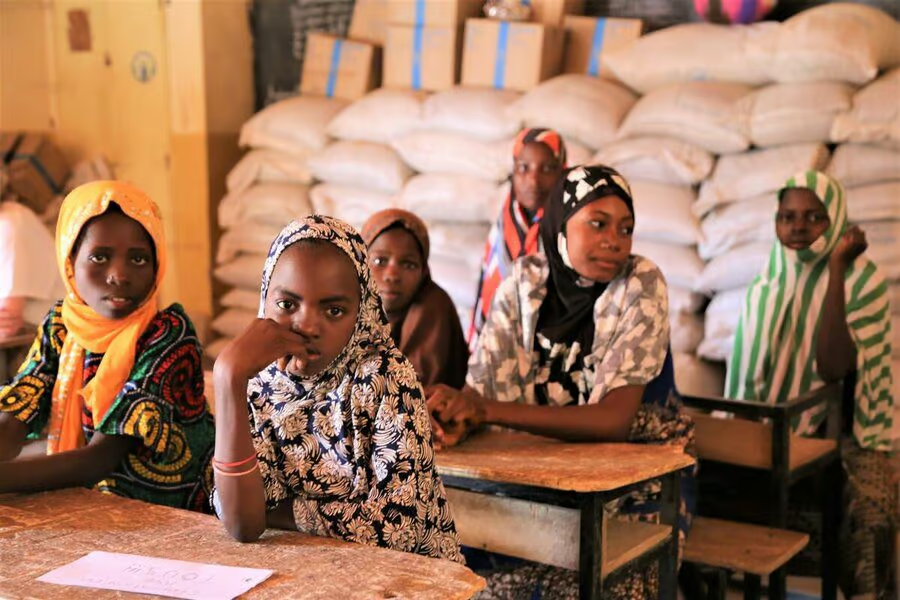
schoolgirls sitting in classroom
School Meals
WFP partners with Niger’s Ministry of Education to deliver school meals and promotes homegrown school meals.
Learn More
A man stands on a hillside surrounded by goats.
Food For Assets
In exchange for food assistance, beneficiaries create or rebuild community assets like ponds.
Learn More
Scroll to Top