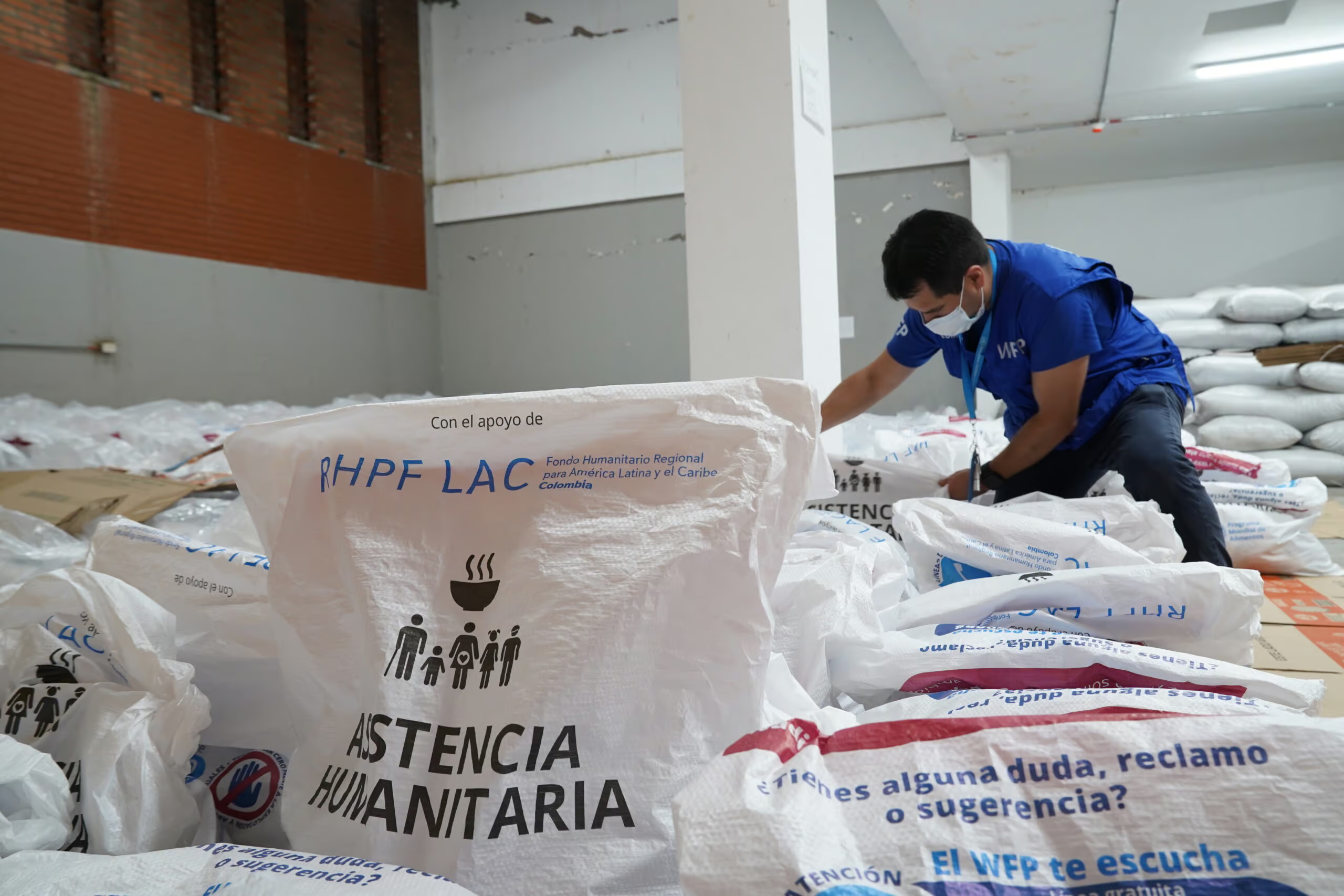
CAIRO/ROME – The World Food Programme (WFP) has stepped up its emergency response to support earthquake survivors in Syria and Türkiye, providing emergency food assistance to nearly half a million quake-affected people in the two countries through hot meals, ready-to-eat food packages and family food rations.
WFP teams in the two countries are delivering immediate relief in the affected areas and at the same time assessing needs and supporting logistics efforts. Because WFP has ongoing operations in both countries, it has partners, staff and a robust supply chain in place. This means the agency could respond to food needs within the first hours of the disaster.
“Families tell me they left everything behind when the earthquake hit, running for their lives. The U.N. World Food Programme’s food is a lifeline for them. While they think about their next steps in the destruction left by the earthquake, their children can eat,” said Corinne Fleischer, WFP regional director for the Middle East, North Africa and Eastern Europe. “We have scaled up rapidly and requests for more food are coming every day from cities and communities. We are there for them, but the U.N. World Food Programme can’t do it alone. We urgently appeal for funding to help us reach those in need.”
In Syria, in addition to providing immediate food assistance in quake-affected cities, WFP has resumed its regular general food assistance for 5.5 million people every month following a brief pause after the earthquakes. This includes regular monthly assistance, either in-kind or cash-based, to 1.4 million people in non-government-controlled areas of the northwest.
Between February 13 – 16, 52 WFP-contracted trucks crossed into northwest Syria through Bab al-Hawa and Bab al-Salam.
With humanitarian access expanded through the opening of two additional border crossing points from Türkiye to northwest Syria, WFP plans to use all three Turkish-Syrian border crossings, Bab al-Hawa, Bab al-Salam and Al Ra’ee, to ensure a constant reach of aid to non-government-controlled areas of northwest Syria.
Prior to the earthquake, food insecurity and poverty in Syria were already at alarming rates with a population suffering the effects of 12 years of conflict and successive shocks. Over 12 million people across the country were categorized as food insecure, including 2.5 million people severely food insecure. In addition, 2.9 million were at risk of slipping into food insecurity.
The Syrian economy is too fragile to withstand external shocks and the earthquake-affected cities of Syria have been severely impacted by the conflict. In northwest Syria, 90% of the population, 4.1 million people, were already relying on humanitarian assistance prior to the earthquake.
“We rely on the international donor community to stand up for Syrians, otherwise, the February 6 earthquakes will turn an already dire situation into an unbearable scenario for millions of people,” says WFP Representative and Country Director in Syria Kenn Crossley. “No population can face this alone after years of conflict, a pandemic and catastrophic economic decline.”
WFP is appealing for $80 million to provide assistance through hot meals, ready-to-eat meals, vouchers and cash.
The agency is also appealing for funding for both the earthquake affected population and the millions of people in Syria that receive the agency’s lifesaving food assistance every month. WFP urgently requires a minimum of $386 million to maintain its regular emergency assistance program across all of Syria.
Without sufficient resources, WFP will be forced to dramatically reduce up to 70% of the people it assists in Syria from July onwards.
# # #
The World Food Programme is the 2020 Nobel Peace Prize Laureate and the world’s leading humanitarian organization, saving lives in emergencies and using food assistance to build a pathway to peace, stability and prosperity for people recovering from conflict, disasters and the impact of climate extremes.
Follow us on Twitter @WFPUSA and WFP @wfp_media