Lesotho

El Niño Drives Hunger

Lesotho is experiencing a major hunger crisis as a result of El Niño-induced drought. WFP delivers food directly to women, men, girls and boys experiencing severe hunger.
Make a difference in Lesotho

Hunger Stats

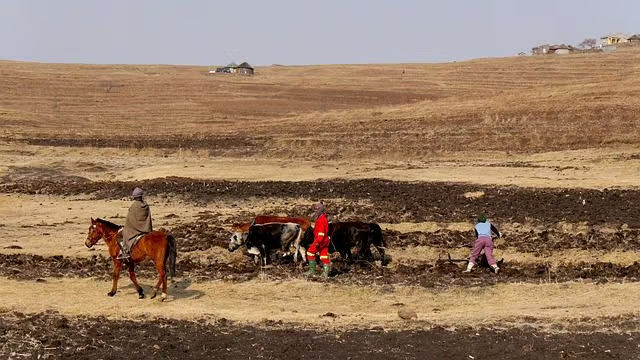
While more than 80% of Lesotho’s population lives in rural areas and most of the country relies on subsistence farming, many households still lack access to agricultural land. Lesotho is highly vulnerable to the impacts of the climate crisis.

Lesotho Facts

New York
Show Places
New York
×
Geocoding Error Occured.

Tried to Geocode:

Error Type:

Please be sure to follow the tutorial on how to setup the Google APIs required for the Advanced Google Map Widget.

Google Map API Key Tutorial
Population: 2.2 million people.
Background: Lesotho became independent in 1966. The country is a constitutional monarchy, ruled by a king as head of state and a prime minister as head of government.
Geography & Climate: Lesotho is a small, mountainous and landlocked country, completely surrounded by South Africa. The country’s climate is temperate, though the climate crisis is making Lesotho hotter and drier.
Economy: Lesotho depends mostly on agriculture and remittances from other countries. More than three-fourths of its population depend on animal herding and subsistence agriculture, while the country produces less than 20% of its own food. Lesotho relies heavily on South Africa for much of its economic activity: It imports 85% of all goods – including food – from South Africa.

Causes of Hunger in Lesotho

No Image

Climate

Lesotho is highly vulnerable to the impacts of the climate crisis, with El-Nino induced droughts already devastating harvest yields and causing significant loss of livestock. The climate is predicted to become warmer and dryer, making droughts and floods more frequent and intense. With less snow on the mountains and an increase in run-off rates, soil erosion will worsen and deplete the soil of nutrients. While some climate adaptation measures are being taken, the country lacks the resources to meet these challenges head on.
No Image

Poverty

More than half of Lesotho’s population live on less than $1 a day, which is categorized as extreme poverty. Low incomes and high food prices mean that 41% of rural families spend over half of their income on food. Meanwhile, land degradation and the impacts of the climate crisis are chipping away at the traditional methods of farming that have financially sustained Lesotho’s communities for generations.
No Image

Inequality

Hunger in Lesotho exacerbates gender inequality. When women in Lesotho face hunger, they often travel long distances to find work. As a result, they are more susceptible to sexual abuse and sexual exploitation. Nearly a quarter of the population is infected with HIV, with women being disproportionately affected due to gender-based violence. Women and children across the country need the most help.
Recent History

WFP’s Work in Lesotho

We’ve been in Lesotho since 1962, delivering food directly to the hungriest people. Even as climate shocks and extreme poverty increasingly devastate communities, we continue to hold fast in our mission to save lives.
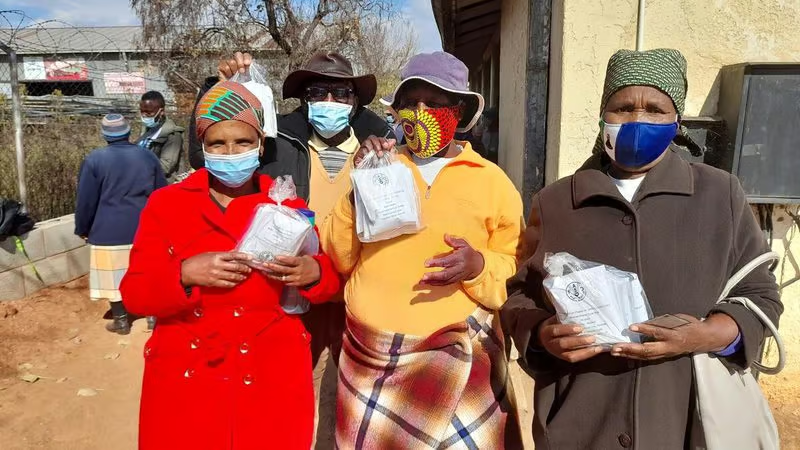
beneficiaries of WFP’s cash based transfers receive vegetable seeds from FAO

With the aim of increasing food access to food insecure families that had been negatively affected by COVID-19 pandemic, WFP, jointly with FAO and IOM, mobilised resources from ECHO to support joint emergency response interventions led by WFP in conjunction with the two agencies. This enabled WFP to launch the urban response programme and provided cash to targeted people.

In complementarity of the activities carried out by WFP, FAO distributed six different types of vegetable seeds to WFP beneficiaries that were benefitting under the urban response programme.
Crisis Response
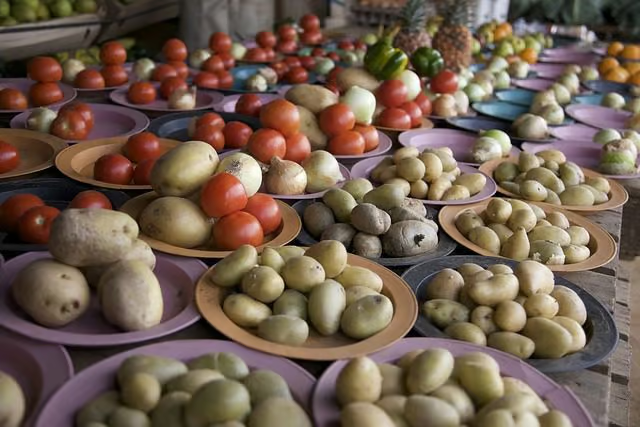
We deliver food and cash assistance and work to strengthen the technical capacity of the government – specifically the government’s early warning systems and food and nutrition security monitoring.
Learn More
lesotho-g23716acb3_640
Nutrition & School Meals
We work with the government and other partners to provide nutritious food. We coordinate across sectors to put equitable food policies and programs – including our school meals program – into action.
Learn More
lesotho-g5c39c2c2b_640
Farmers
We help communities affected by the climate crisis. For small-scale farmers, we provide agricultural trainings, tools, cash assistance and other resources to ensure they can grow enough food to feed their families.
Learn More

Latest News From Lesotho

Scroll to Top