Working for a global humanitarian organization like the World Food Programme (WFP) is challenging, inspiring and rewarding all at once. But where to begin? We are often asked:
- How do I intern for the U.N.?
- How do I volunteer for the U.N.?
- How do I work for the U.N.?
- How do I pursue a career in humanitarian work?
All of these paths are possible for Americans like yourself looking to make a difference. If you’re considering a career in humanitarian work, start here by reading the stories of these young Americans who are working for WFP. Then, sign up for the Zero Hunger Generation, World Food Program USA’s youth movement to end hunger. We’re empowering young Americans everywhere to pitch in their time, voices, and networks to make Zero Hunger a reality.
Nick Paiva, Resilience Officer in Chad

Nick Paiva grew up in the suburbs of Sacramento, California. . He studied agribusiness, specifically wine production, in college and joined the Peace Corps after graduation. Stationed in rural Panama, Nick helped coffee growers apply for government and NGO funding.
“Serving with the Peace Corps made me feel very connected with the indigenous community and their land. It completely changed my perspective on service.”
When Nick returned from Panama, he decided to pursue a Master of Science in Foreign Service from Georgetown University with a focus on agriculture and sustainability. This experience gave him more technical knowledge of agriculture and facilitated connections in the development world. After successfully completing his master’s degree, Nick applied for and was accepted into the Junior Professional Officers (JPO) program with WFP.
“Peace Corps was the heart and grad school was the head of my decision to accept the field position with WFP and pursue this type of career.”
In his first year as a JPO, Nick worked in supply chain logistics, cash and voucher assistance, market retail and onboarding. He later transferred to the resilience programming side of WFP’s work, where he now manages $28 million in projects strengthening value chains for enriched flour.
Q: What have been some highlights of your career?
NP: It has been really satisfying to see my project ideas through their entire lifespan. After introducing ideas to the country office and securing approval, I am able to be present (on the ground) as they come to fruition. For example, I was able to facilitate the construction of warehouses to combat post-harvest loss and waste and then go back to the procurement side to explain our progress.
Q: What skills have aided you in your career?
NP: I think being a strong writer is critical, especially in environments where English is not many people’s first language. Additionally, being able to take data and create visualizations to simplify complex information has been really valuable.
Developing and having a resilient attitude is also important. Knowing that projects and ideas don’t always secure funding or work the first, second, or sometimes third time, but not giving up. You learn to keep adapting and trying and leaning on your network to help you out when you need it.
Building partnerships is also essential. I’ve worked with a variety of different stakeholders before and during my tenure with WFP, ranging from donors, institutions, government officials, servicemembers, ambassadors and more. These connections are critical to help your current role and advance to the next one.
Q: What advice would you give to young people hoping to pursue this type of career?
NP: Be open to learning about and pursuing as many opportunities as you can! Also make sure you are taking good care of yourself. Sleeping, eating well and going to the gym have been so important to my mental health so I am equipped to handle the challenges of working in the field.
Laura Cantave, Communications & Outreach Officer/Consultant with WFP HQ/Rome Ethics Office

Laura is Haitian American and grew up between Haiti and Miami, Florida. In Miami, she was raised in a diverse community with many other people from Latin America and the Caribbean and participated in choir and youth group at her local church. In Haiti, she itnessed poverty and inequality from a young age. Together, these experiences taught her the value of taking care of each other and your community amidst challenging circumstances.
Laura went on to earn a bachelor’s degree in economics followed by a master’s degree in government & politics, specializing in International Relations, International Law and Diplomacy. During her academic career she studied abroad in Italy and France and conducted human rights field research in Morocco.
“My master’s degree included a strong focus on International Law, where I concentrated much of my research on human rights cases across Africa, the Middle East and Asia. This research instilled in me a profound sense of urgency to get involved and contribute to meaningful solutions.”
After successfully completing her master’s degree, Laura began her career with WFP as an intern in the legal department, which solidified her interest in the field and understanding of the inextricable connection between food security and human rights. She has since been deployed to numerous Sub-Saharan African countries, including Senegal, Togo, Sierra Leone, Mozambique, Ethiopia, Chad and Cameroon, where she worked in emergency operations, cash-voucher transfers and communications.
Q: What have been some highlights of your career?
LC: My career with WFP is filled with countless highlights that have shaped me both professionally and personally. I have had the privilege of immersing myself in diverse cultures, savoring incredible foods and meeting people from around the world — each drawn to this journey for their own reasons.
In Ethiopia, I have traveled to the Amhara Region to assess WFP’s Fresh Food Vouchers programs and its effectiveness. The journey through steep hills was grueling, but the reward was immense — witnessing Ethiopia’s breathtaking countryside and visiting local markets to understand the program’s impact firsthand. We spoke with women who believed vegetables were only for the wealthy and lacked access to phones or feared owning them due to the literacy challenges involved. Through WFP’s fresh food vouchers program, these women learned more about nutrition and health and gained access to mobile money to buy food.”
In Mozambique, I was deployed for the emergency response to Cyclones Kenneth and Idai in 2019. I met people from all walks of life — many with the scars and tattoos of war etched on their faces — who found themselves in desperate need after the cyclones. These were not just ordinary people; they were warriors with stories of strength and resilience, continuing to strive for a better future despite their vulnerabilities.
In West Africa, I had the unique opportunity to work in communications, where I conveyed the complexities of food security to governments, stakeholders and audiences both inside and outside the organization. It was a challenging role, but in each country, I met individuals who were proud to work with WFP and motivated to share stories of hunger and hope from Africa.
Q: What skills have aided you in your career?
LC: Entering (emergency) operations requires significant internal strength, as the images one encounters, especially those related to war and post-conflict situations, do not easily fade. My career has allowed me to develop numerous professional and personal skills, including endurance, advanced communication abilities and a deep understanding of forgiveness. Forgiving those who cause harm while working in a world where many strive for hope and peace has been a crucial perspective that has greatly supported my career over the years.
Q: What advice would you give to young people hoping to pursue this type of career?
LC:For young people pursuing this career, hold onto hope, stay adaptable, embrace learning and do not fear failure. Learning a new language, pursuing another degree or taking a new class can be great starting points. Remember every individual has unique qualities to offer.
Hannah Peterson, Programme Policy Officer, Head of School Feeding in Addis Ababa, Ethiopia

Hannah grew up in Atlanta, Georgia. When she was nine years old, she traveled around Africa for six weeks with her family – and continued to return to the continent many times before graduating high school. Her travels exposed her to communities completely different from her own and inspired her to study French for her undergraduate degree at the University of Virginia (UVA). At UVA, she also took courses on the history of the humanitarian system, including the role of the United Nations, and global food insecurity, which solidified her desire to work in the humanitarian aid and food assistance space. Hannah went on to obtain her Master of Public Policy from UVA, where she also served as a teaching assistant for the Global Humanitarian Crises and Response class.
After graduation, she joined the WFP Washington Office for three years as a partnerships officer, where she managed donor relations and provided support to WFP country offices and governments receiving assistance from the McGovern-Dole International Food for Education and Child Nutrition program. In 2023, Hannah moved to WFP Ethiopia Country Office, where she still works today managing the school meals program.
Q: What have been some highlights of your career?
HP: I’m most inspired when I visit the field. It connects you to the work you do and keeps you motivated. Getting to see the kids as they eat school meals is the best part of the job. Especially the programs that use locally grown products, which support the communities the kids are living in and help them attend school. WFP is also unique in that it is able to reach very remote communities, even those that are not accessible by car. We ensure food reaches where it needs to go, sometimes even by donkey or camel, because we are committed to reaching the most vulnerable people.
It is also incredible to see areas that are completely transformed through WFP programming. There is a region in Ethiopia where only 7% of the land is suitable for agriculture, and access to fresh food in these areas is limited. Through a fresh food pilot program, wesupported school gardening initiatives and helped small-scale farmers to produce fruits, vegetables and animal products for the school meals program, which in turn strengthened the local food system.
Q: What skills have aided you in your career?
HP: Knowing another language has been critical for me. I studied French for my undergraduate degree, which has allowed me to work in various offices where English is not the official business language.
Being able to work with a variety of different people is also vital. Be open minded about what working culture and professionalism looks like across countries and cultures is important.
Humanitarian scenarios are also complex, so being able to manage your time and information is crucial. You have to think critically to make decisions and problem solve with the information that is available to you.
Q: What advice would you give to young people hoping to pursue this type of career?
HP: One of the beauties of working in the humanitarian space is there is a place for everyone, no matter your academic or personal background. For example, our office here has a team of engineers, a finance team, program staff, monitoring and evaluation specialists, logistics teams, and more. There are so many ways to get involved.
Do not be afraid to pursue internships and opportunities that seem scary, like going abroad. Gaining field experience is so valuable to understand what is happening on the ground, and it’s great to do so early if you are able.Also, reach out to people on LinkedIn, through professors and beyond, to learn more about what you are interested in! The worst thing that can happen is someone will not respond. You never know when you could make a lasting connection or maybe work with that person someday.
Haley Hardie, Partnerships Officer and USDA Team Lead at WFP Washington

Haley Hardie grew up in a rural community in South Dakota, where her father’s stories about his time living in the Middle East sparked a lifelong interest in global challenges and a deep sense of empathy. From a young age, she was drawn to service and volunteered her time at the local humane society, Habitat for Humanity, and the Salvation Army
Haley went on to pursue an undergraduate degree in political science at Davidson College and a graduate degree in international relations at Syracuse, where she focused on international development and humanitarian assistance. In college, she volunteered with a local homeless center and was later selected as a Truman Scholar, a graduate fellowship awarded to those dedicated to public service.
“Volunteering during my college years at a local homeless center redefined my understanding of public service and taught me the importance of listening deeply, learning from others, and working in partnership with communities.”
After several years working in international education and public health, Haley joined WFP as a partnerships officer and U.S. Department of Agriculture (USDA) team lead. She applies her experience and passion for nutrition, health and education to her daily work supporting WFP’s school meals programs.
Q: What skills have aided you in your career?
HH: I believe critical thinking, problem solving and effective communication are all skills that have been essential throughout my career. The ability to be flexible and a quick, creative thinker is essential when working in an environment as complex and fast-paced as the World Food Programme.
Additionally, having experience with operational skills, such as grant writing, project design, budgeting, and developing monitoring and evaluation frameworks, are big assets when working in the humanitarian sector. Whether it’s supporting emergency response or co-designing long-term development programs, I’ve found this combination of broad-based thinking and specialized training has helped me work effectively alongside diverse teams and communities.
Q: What advice would you give to young people hoping to pursue this type of career?
HH: Approach your work with curiosity, humility and a genuine commitment to service. Recognize that your role is to listen, collaborate and contribute respectfully in complex environments rather than to “fix” things. During difficult moments, remember your work is part of a broader, collective effort to support communities facing profound challenges and that showing up with care and integrity carries deep meaning. Ultimately, remember this is not just a job; it is a long-term commitment to learning, growing, and engaging with purpose.
Q: Anything else you would like to share?
HH: If you’re looking for a space where you can contribute to systems-level change while making a tangible, daily impact in communities, I highly encourage you to look into school meals programs. These initiatives go far beyond providing food, they support children holistically by bringing together education, nutrition, health, WASH, agriculture, market development, and government capacity strengthening. This comprehensive approach creates a supportive ecosystem that improves children’s academic experience and overall well-being. It’s a dynamic and impactful area in international development!
Alexandra Brennan, Regional Partnerships Officer in the WFP Latin America and Caribbean Regional Office
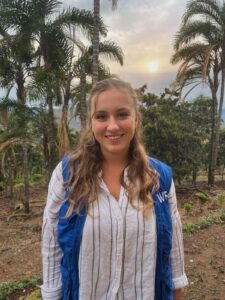 Alexandra Brennan grew up in Pittsburgh, Pennsylvania, in a family that valued empathy, meeting people from other cultures, and giving back to the community. As a teenager, Alex volunteered often and became involved in an organization that created jobs in Haiti, which would shape Alex’s academic and professional path for years to come.
Alex studied international relations at American University in Washington, D.C. During her undergraduate studies, Alex applied for an internship with WFP, an opportunity that would launch a long-term career with the organization.
“I’ve always believed in helping people help themselves. Food is such a basic human right, and WFP supports communities to meet their immediate needs while also building sustainable food systems.”
After interning with WFP, Alex joined their Washington, D.C. office, where she worked for nearly five years before moving to the Regional Bureau in Panama. In her current role, Alex draws on a strong partnerships background to understand what donors are looking for and to communicate WFP’s work in the Latin America and Caribbean region effectively.
Q: What have been some highlights of your career?
AB: One of the things I love about WFP is it’s an agency that truly makes things happen. During the COVID pandemic, WFP flew more flights than many commercial airlines to keep supply chains open. I’ve been surrounded by colleagues who will do whatever it takes to make sure people can eat.
Q: What skills have aided you in your career?
AB: Adaptability has been key — being comfortable with being uncomfortable and figuring things out quickly. Building relationships has been essential, as has strategic thinking and multitasking. A lot of my role involves telling government representatives the story of why they should invest in our lifesaving work. Being open to learning new things, pitching in wherever needed and cultivating trust has helped me succeed in fast-paced environments.
Q: What advice would you give to young people hoping to pursue this type of career?
AB: Be kind, be authentically yourself and put yourself out there. Be willing to help — you never know who you might meet or what opportunities might come your way.
A lot of times, people, especially women, don’t apply for roles because they think they aren’t qualified enough. But if you’re willing to learn, adapt and work hard, you might be more qualified than you think. My first job with WFP came from a coffee meeting with a director when I was an intern. Later, someone asked if I wanted to move to Panama to support WFP’s work in the region. I said yes—and it turned into one of the best decisions of my career.
Q: Anything else you’d like to share?
AB: Zero hunger might seem impossible, but every step forward counts. It’s easy to feel apathetic when the challenges are so big, but you can make a difference. Some progress is better than no progress.
These are just a few of the many Americans who work for WFP – and many of them still young in their careers. We hope their journeys inspire you to pursue a career in humanitarian aid. Remember, the best time to start is right now through World Food Program USA’s Zero Hunger Generation. This new initiative allows you to take action for a world without hunger and get involved with our work directly – all while earning points with the opportunity to win prizes, build your resume and network with other humanitarian professionals.