PANAMA CITY, Panama – As Tropical Storm Melissa moves slowly across the Caribbean bringing heavy rains and strong winds, the World Food Programme (WFP) is working with governments and partners to help communities prepare for and reduce the storm’s impact. Forecasts suggest the storm could develop into a major hurricane over the weekend.
WFP’s efforts across the Caribbean are focusing on early action, helping people before disaster strikes to preemptively protect food insecure communities.
“We know from experience that the most vulnerable members of society – women, children and the elderly – can be the hardest impacted by disasters so it’s critical that we’re able to reduce this as much as possible and speed up recovery,” said Lola Castro, WFP regional director for Latin America and the Caribbean. “Taking early action helps with this. Prevention is always better, and cheaper, than dealing with a full-blown crisis, and these anticipatory actions are even more critical as WFP forges ahead in an increasingly constrained funding environment.”
WFP’s Preparedness Actions
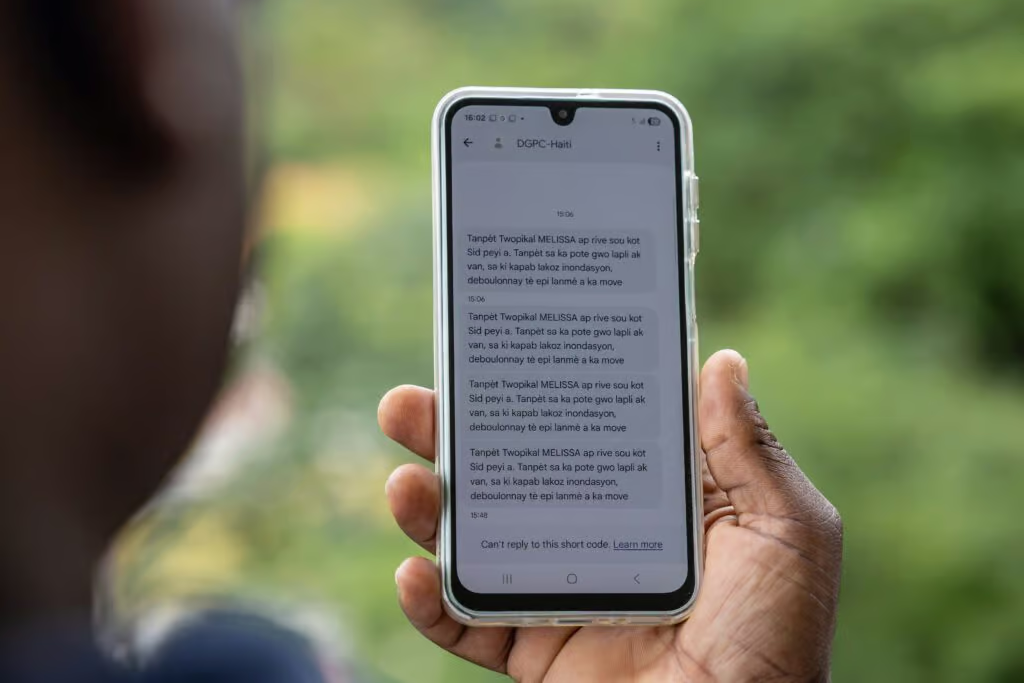
In Haiti, heavy rainfall is expected to lead to flooding and road closures in the southwest of the country. The Haitian government and WFP have sent more than 3.5 million text messages to provide practical guidance on how to prepare, stay safe and reduce injuries and damage to homes and assets.
To further support communities, WFP is providing anticipatory e-money distributions to meet urgent humanitarian needs and help people protect their livelihoods ahead of the storm. The distributions will reach approximately 45,000 people and total $900,000.
In Jamaica, WFP is coordinating with the government and the Caribbean Disaster Emergency Management Agency, to support with emergency logistics and telecommunications, supply chain and food and cash assistance as required. WFP has also partnered with the government and the Caribbean Catastrophe Risk Insurance Facility, a sovereign insurance mechanism, to enable access to quick financial liquidity for vulnerable impacted households via national social protection systems, should the tropical cyclone policy for wind speed trigger.
In Cuba’s eastern region, which is most at risk, WFP and the government have prepositioned food supplies to support 275,000 people for up to 60 days. This will ensure an immediate response to potential disruptions caused by the storm.
In the Dominican Republic, more than 4,000 vulnerable households in flood-prone areas will receive cash to prepare for the storm and reduce the impact on household food security. If needed, emergency food assistance will be activated in the southwestern provinces to reach up to 6,000 families with ready-to-eat meals for five days and dry meals for 15 days.
At the government’s request, WFP is supporting response planning through the Automated Analysis System for weather events and Operational Alerts platform, strengthening evidence-based preparedness and coordination.
On a regional level, the WFP Caribbean Regional Logistics Hub in Barbados has more than 500 pallets of relief supplies and logistics assets from partner organizations prepositioned for air and sea deployment to affected countries. The most urgent items can be airlifted, while additional supplies are ready for maritime transport.
Additionally, the WFP-managed United Nations Humanitarian Response Depot (UNHRD) in Panama stands ready to deploy its Field Emergency Team and dispatch over 2,000 pallets of lifesaving supplies — covering shelter, health, WASH and logistics — from WFP’s corporate stocks and 16 humanitarian partners.
WFP’s preparedness and anticipatory actions efforts across the Caribbean are supported by the UN Central Emergency Response Fund (CERF), the European Civil Protection and Humanitarian Aid Operations (ECHO), the United States, Canada and Ireland among others.
# # #
The World Food Programme is the 2020 Nobel Peace Prize Laureate and the world’s leading humanitarian organization, saving lives in emergencies and using food assistance to build a pathway to peace, stability and prosperity for people recovering from conflict, disasters and the impact of climate extremes.
Follow us on X, formerly Twitter, via @wfp_es
Originally posted on wfp.org