This article was originally published on wfp.org
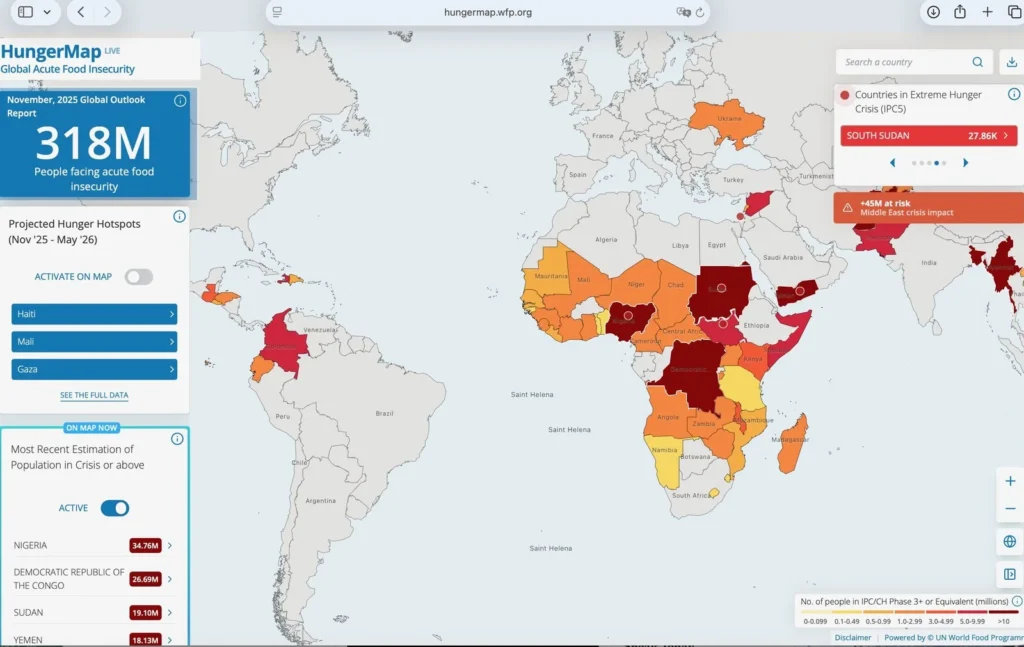
NEW YORK – The World Food Programme (WFP) today released its next-generation platform, HungerMap Live, a powerful digital monitoring and intelligence capability that integrates a wide range of food security data and analysis with predictive modelling to help fight hunger in more than 50 countries.
At a time of rising food security needs and limited funding for humanitarian action, HungerMap Live provides the most complete and updated picture of hunger in the world’s most vulnerable countries.
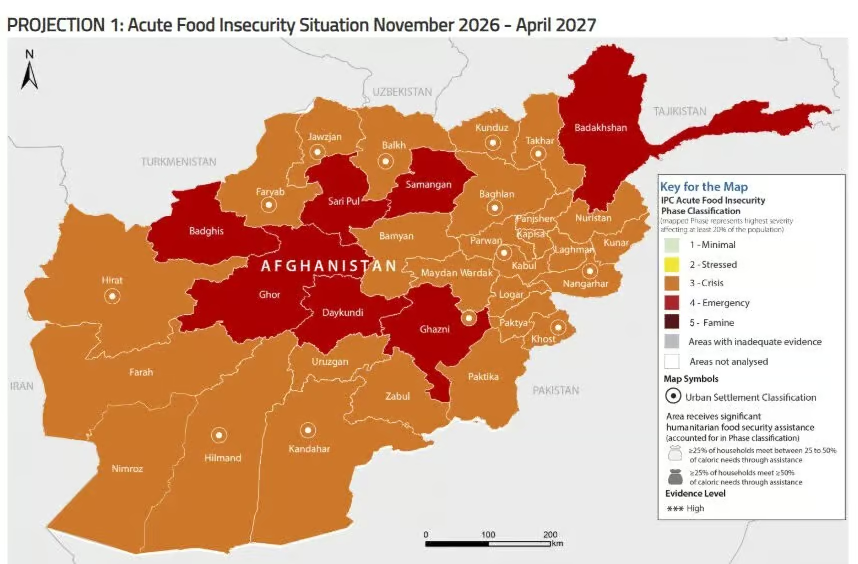
HungerMap Live offers AI-assisted forecasting capabilities of projected food needs in WFP designated Hunger Hotspots – 16 countries with populations already struggling with catastrophic hunger. Studies have shown that early warning of emerging food security issues can reap tremendous cost savings and operational efficiencies. In fact, WFP has seen first-hand that every dollar invested in its anticipatory action programs, reaps a minimum of seven dollars in savings.
The release of the platform comes at a critical time when the number of people facing IPC5 food insecurity – the most severe form of hunger – has increased 15-fold from 85,000 in 2019 to 1.4m in 2025.
The newly modernized HungerMap Live platform brings together data from WFP’s extensive network of more than 300 analysts working on food security monitoring and mapping with information from dozens of trusted partners. This includes the global benchmark for food insecurity data (known as IPC), government validated statistics, climate, market, agricultural and economic data.
Through predictive modelling, provided with the support of Google.org, HungerMap Live answers three critical questions: what is the current state of food security across the world? Which countries and regions require urgent attention? And what are the underlying factors contributing to food security needs?
“Without data, the fight against hunger is fought in the dark,” said WFP Executive Director Cindy McCain. ”This platform changes that, combining WFP’s on-the-ground insights with critical data to give decisionmakers, communities, humanitarian agencies and donors, the power to act before hunger costs lives. We’re able to track and predict where, how and why hunger is growing, which means that we don’t just respond to hunger – we get ahead of it.”
A specialized layer on “micronutrient intake adequacy” links food-security conditions with the nutritional quality of diets. This nutrition analysis, developed with support from the Gates Foundation, helps identify populations at risk of hidden hunger caused by inadequate intake of essential vitamins and minerals.
Funding for global food security monitoring and analyses has been on an alarming decline with WFP’s data footprint having shrunk by 25 percent in the past year.
“You can’t stop hunger if you can’t see it coming,” added Jean Martin Bauer, director of WFP’s Food Security and Nutrition Analysis Service. “That’s why it’s crucial that we keep funding the collection of this data, so that society has a trusted, evidence-based early warning system, that can alert the world about emerging and alarming conditions, and the risk of human suffering, before it’s too late.”
HungerMap Live is available now at hungermap.wfp.org.
# # #
The World Food Programme is the 2020 Nobel Peace Prize Laureate and the world’s leading humanitarian organization, saving lives in emergencies and using food assistance to build a pathway to peace, stability and prosperity for people recovering from conflict, disasters and the impact of climate extremes.